 Reno Swamp Cooler Repair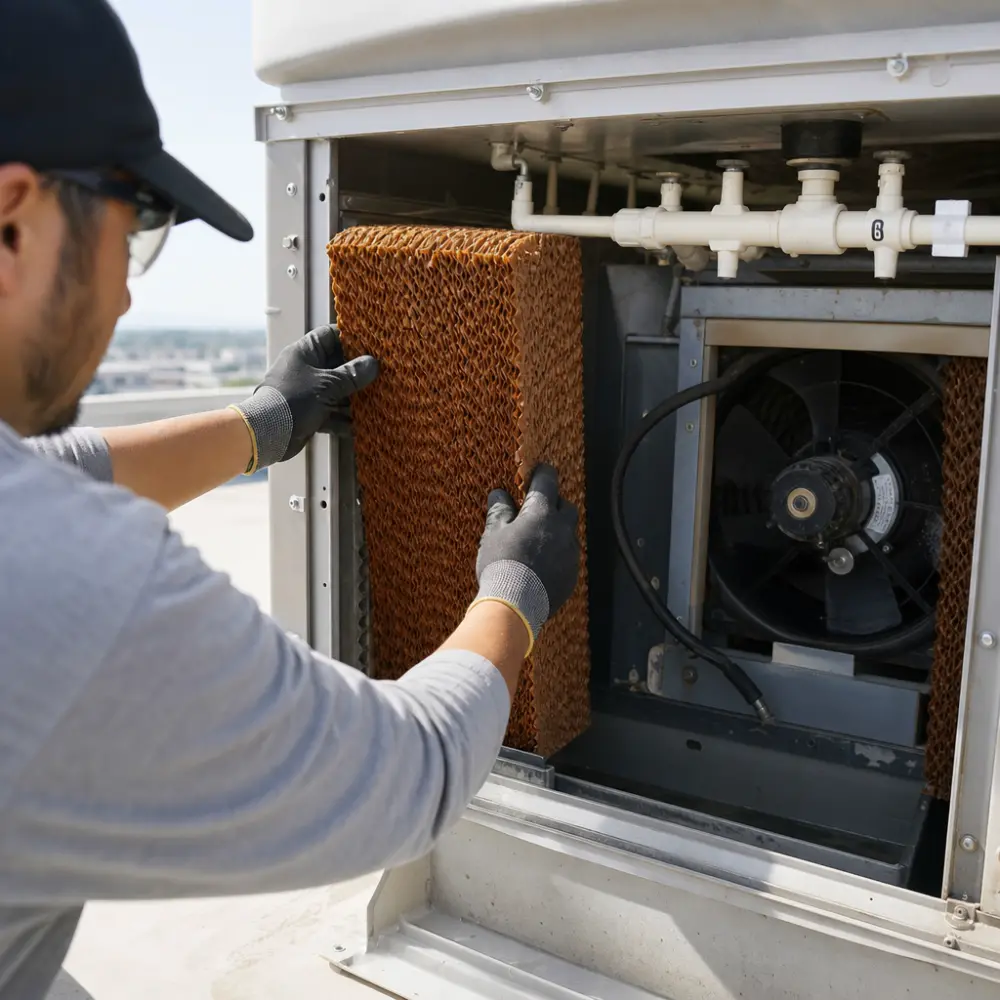
Reno Swamp Cooler Repair fixes, services, and replaces evaporative coolers on homes across Reno, Sparks, and the valleys around the Truckee Meadows. A service call runs $150 to $350 and covers the roof visit and the first hour; pumps and floats are $100 to $400, motors $300 to $700, a spring start-up $120 to $250, fall winterization $100 to $200, and a new roof-mount cooler installed $1,500 to $4,000. Send a photo of the cooler with the panel off and you get a straight diagnosis and a real number, usually the same day, and same-day service in season when a roof is blowing warm air in July.
Swamp coolers work in Reno because Reno is dry. The city sits at about 4,505 feet on the east side of the Sierra, in the rain shadow, and NOAA’s 1991-2020 normals for the airport give it 7.40 inches of precipitation a year, only 0.20 of an inch of that in July, and a July relative humidity that averages 36 percent. Push 94 degree air through wet pads in that climate and it comes out in the low 70s for the cost of running a blower motor. The catch is that the same climate that makes coolers work also breaks them: the roof bakes the belt, a season of evaporation leaves a crust in the pan, the nights swing 30 degrees colder than the days, and a hard freeze splits any water line that was not drained in the fall. Everything on this site is about keeping that box working, or telling you honestly when it is time to replace it.
What we fix
- Swamp cooler repair: warm air, no air, water on the roof, squeals, hums, smells, and electrical faults diagnosed by symptom and fixed on the first visit whenever the part is on the truck.
- Spring start-up service: pan cleaned, pads set, bearings oiled, belt tensioned, float set, water line pressure-checked, every speed tested.
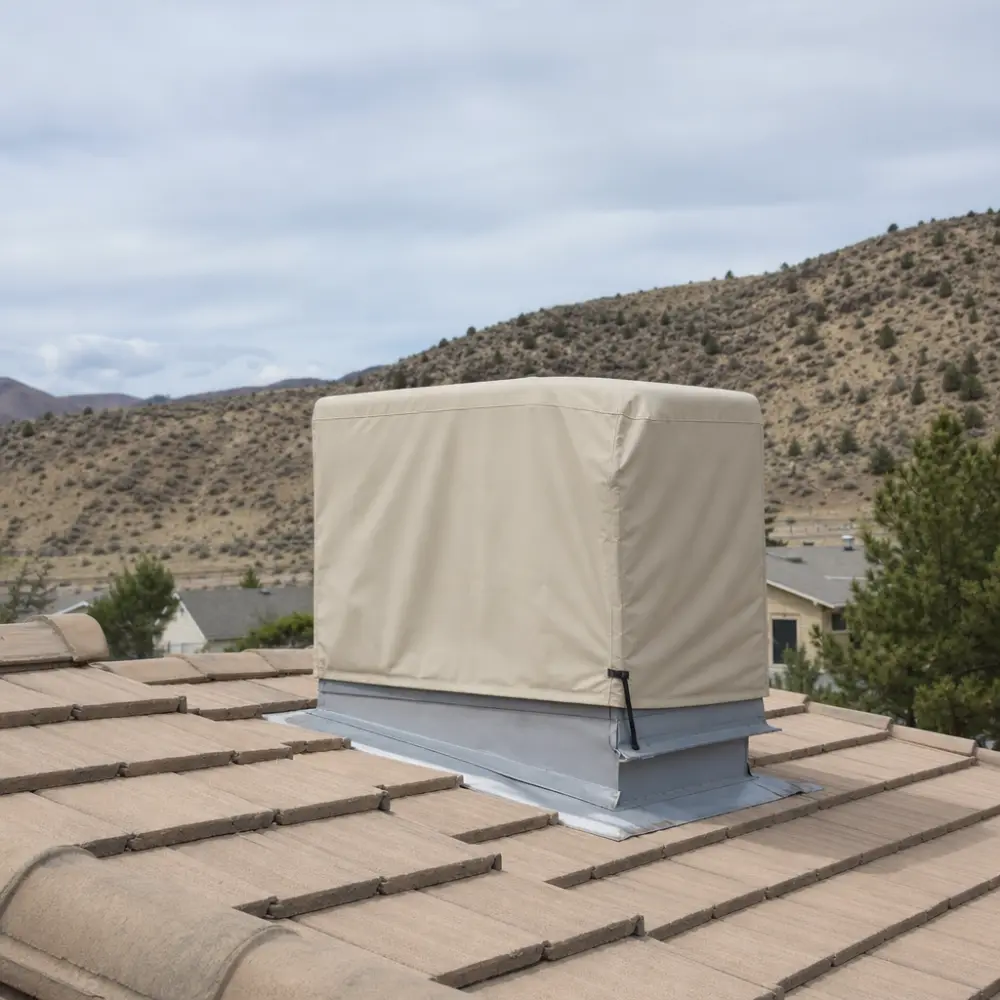
- Fall shutdown and winterization: water off, line and pan drained, pads out or dried, cover on, duct damper sealed against a Reno winter.
- Pad replacement: aspen or rigid media measured to the frame, with the bleed-off set so they last the season instead of crusting by August.
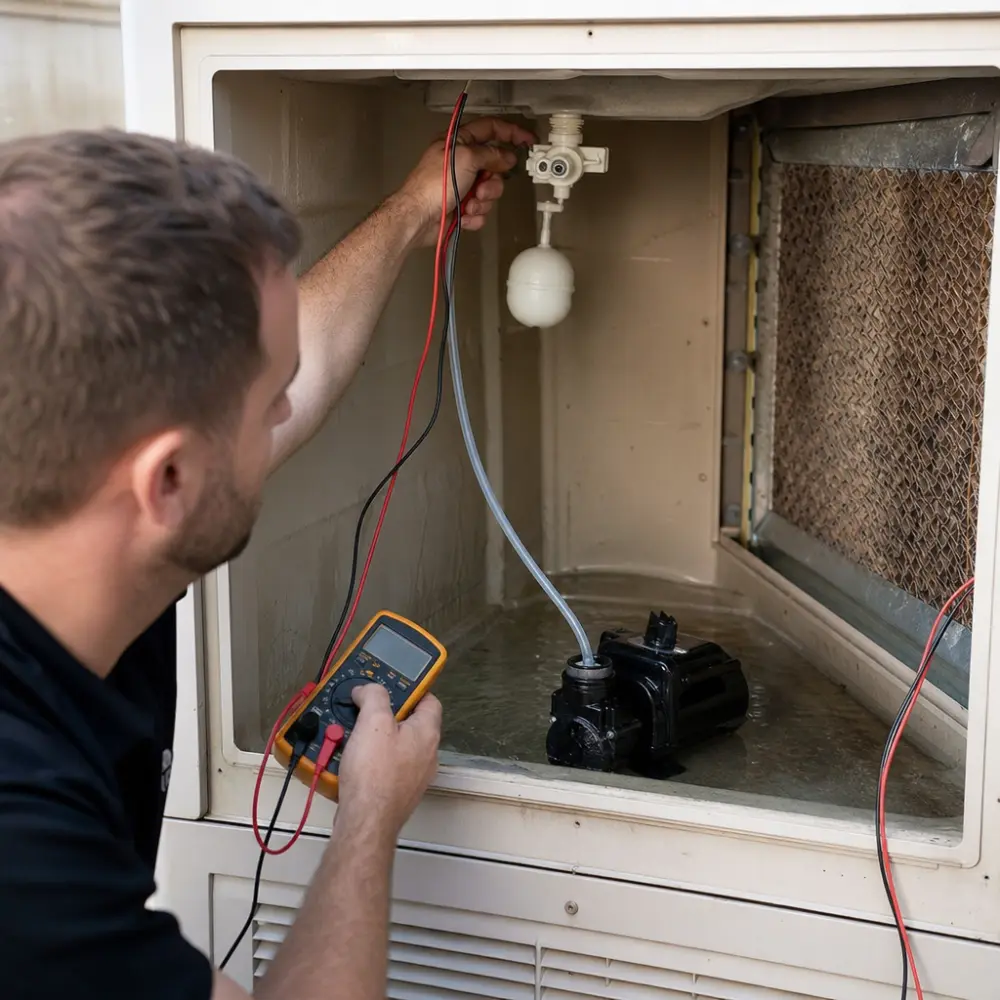
- Pump and float valve repair: the two water-side parts behind most warm-air and overflow calls, replaced with the right size for the cooler.
- Motor, bearings, and belt: hums, squeals, and no-air calls traced to the cheap part first, and a motor only when it is really the motor.
- Swamp cooler installation and replacement: new roof-mount, side-draft, or window coolers sized to the house, ducted, and permitted through the right office.
If you would rather start from the symptom, the problem pages walk through what the cooler is doing and what the fix costs. The free calculators price a repair, a season of pads and service, or a month of running costs on the page with no email. And if you are weighing whether to stay on evaporative cooling at all, the cooler versus refrigerated air page lays out the trade honestly.
Why Reno is swamp cooler country
The air is dry enough, almost all summer. NOAA’s normals for Reno-Tahoe International Airport put the July normal high at 93.9 degrees and August at 92.1, with 53.9 days a year reaching 90 or hotter and 3.4 days reaching 100. What makes that heat cooler-friendly is the moisture, or the lack of it: the airport’s long-term average dew point in July is only about 40 degrees, and at that number a well-padded cooler drops incoming air 20 to 25 degrees. That is why so many houses in the older parts of Reno and Sparks still have a cooler on the roof. They were built before central air was standard, and in this climate a cooler was the right call.
The monsoon days are the exception, and they are few. Reno does not get the weeks-long monsoon that Phoenix or Albuquerque do, but the moisture reaches this far north in bursts. The National Weather Service office in Reno logged “a return of monsoonal moisture” from July 21 to 25, 2024, with a thunderstorm that dropped about 2 inches in under an hour on the Hidden Valley neighborhood, and “a sustained push of monsoon moisture” from August 23 to 28, 2025, that produced nine flash flood warnings in five days. On afternoons like those, the air is too wet for pads to do much and a cooler feels like a humidifier. It is not broken. The muggy-house page explains what to do while it passes, and most summers it passes in a few days.
The water is soft on average and unsteady in practice. The Truckee Meadows Water Authority treats Truckee River water at its Chalk Bluff plant in northwest Reno and its Glendale plant in Sparks, and river water is soft: TMWA’s own area reports show Central Southeast Reno at 1.9 to 3.6 grains per gallon across the last four quarters and Old Sparks at 3.9 to 5.4. What the same reports also show is how far the number moves by area and by quarter. Southwest Reno read 13.9 grains in the first quarter of 2026 and 2.6 in the second; West Reno read 10.4 and then 6.7. TMWA says plainly that from mid-April through October it augments supply with groundwater wells and that doing so can and does change the water chemistry somewhat, so what your cooler drinks this summer is not a number to assume. Whatever the number, every gallon a cooler evaporates leaves all of its minerals in the pan, and a season of that is a white crust on the pads and a scaled impeller in the pump. The pump and float page covers the bleed-off fix.
The nights are cold, even in July. Reno’s diurnal swing is large: the July normal high of 93.9 comes with a normal low of 60.4, and June and September lows sit in the low 50s. A cooler that is right at 3 p.m. is overcooling the house by 10 p.m., and the thermostat or two-speed switch matters more here than in most cooler towns. The too-cold-at-night page covers it.
The freeze is real and it comes at an awkward time. NOAA’s normals give the Reno airport a 10 percent chance of a first 32 degree night by October 5, a 50 percent chance by October 19, and a 90 percent chance by November 2. Sparks runs a couple of weeks earlier at October 5 for the 50 percent date, Carson City earlier still at October 1. A cooler left full of water into that first hard night splits its quarter-inch supply line and sometimes the float and pump housing. The most common spring repair we see is a cooler that was never drained. The winterization page has the checklist and the October post picks the week.
Spring is late and unreliable. The 50 percent date for the last 32 degree night at the airport is April 26, and there is still a 10 percent chance of a freeze after May 12. Sparks’ cooperative station puts its 50 percent date at May 10, Carson City’s at May 19. That is why start-ups get booked from late April into May, and why the April post exists.
Reno’s housing stock, and where the coolers are
Reno was established in 1868 with the railroad and grew in rings. The rings that predate central air are where the coolers live:
- The Old Southwest and the Newlands district. Reno’s oldest prestige neighborhood, south of the Truckee River, was named to the National Register of Historic Places as the Newlands Heights Historic District in 2017. The homes are the bungalows, period revivals, and cottages of the early twentieth century, on big lots under old trees. Steep roofs and finished attics mean side-draft and window coolers are common here alongside roof-mounts, and access is the thing that moves a quote.
- Country Club Acres and the mid-century southwest. The Historic Reno Preservation Society traces Country Club Acres from the 1920s and 30s into a wave of suburban building in the early 1940s. Low-slope post-war ranches with a down-draft cooler on a curb over the hall are the easiest roofs in the county.
- Sparks north of the tracks. Sparks was founded in 1904 as a Southern Pacific division point, and its housing boom came in the 1950s on the north side of the railroad. Those ranches are the heart of the Sparks start-up and shutdown calendar.
- The newer valleys. Spanish Springs nearly doubled between 2000 and 2020 and Fernley more than quadrupled since 1990. Newer tract homes mostly have refrigerated air, but a lot of them carry a cooler too, which is exactly where a leaky duct damper costs money in both seasons.
How a repair visit goes
- Roof access and a full look. Panels off, then pads, pan, pump, float, belt, motor, and the water line all get inspected before anyone quotes a part. A dead pump with a rusted pan behind it is a different conversation from a dead pump alone.
- Diagnose by symptom. Warm air means water: pump, float, pads, or supply. No air means drive: motor, belt, capacitor, or the switch. Water on the roof means float, overflow, or pan. A smell means a stagnant pan, algae, or pads past their life.
- Repair with matched parts. Pump GPH and pad dimensions vary by cooler CFM, and a two-speed motor is not a single-speed motor with a second wire. The truck carries the common sizes.
- Balance the system. Pad saturation checked on every side, the bleed-off or purge set to fight scale, the damper and the window relief adjusted so air actually leaves the house.
- Test every speed and leave you with what to watch for.
Honest pricing, published
| Service | Typical range |
|---|---|
| Service or diagnostic call (roof visit + first hour) | $150 to $350 |
| Pump replacement, installed | $150 to $400 |
| Float valve | $100 to $250 |
| Aspen pads, per set | $80 to $200 |
| Rigid media pads | $300 to $700 |
| Belt, with the visit | $40 to $100 |
| Motor replacement | $300 to $700 |
| Spring start-up (pads extra) | $120 to $250 |
| Fall shutdown and winterization | $100 to $200 |
| New cooler installed, roof-mount or side-draft | $1,500 to $4,000 |
The full table, what moves each number, and the start-up plus shutdown package are on the pricing page. The short version: cooler size, roof access, and what actually failed set the price, and a photo with the panel off gets you a number without a sales visit.
Who does the work, and who licenses them
Nevada licenses this trade at the state level through the Nevada State Contractors Board. The handyman exemption in NRS 624.031 for repairs under $1,000 specifically does not apply to work of a type performed by a refrigeration, heating, or air-conditioning contractor, and NAC 624.380 defines the C-21 classification to include the installation, repair, service, and maintenance of equipment that uses evaporation to control air temperature in a building. In plain terms, the person on your roof should hold a C-21 license, or work for someone who does, and you can look the number up on the board’s website before they climb.
Reno Swamp Cooler Repair is an independently operated local service. Repairs, installations, and seasonal service are performed by Nevada State Contractors Board licensed, insured evaporative cooler technicians. Anything electrical beyond the cooler’s own control circuit goes to a licensed electrician, and we will tell you when that applies before it shows up on a bill. The Nevada rebates, permits, and licensing page has the detail, including the honest answer on NV Energy rebates: we could not find one for evaporative coolers.
Where we work
Crews cover Reno and Washoe County, including Sparks, Sun Valley three miles north of the city, and Spanish Springs on the northeast side of the valley. South, Carson City is its own consolidated municipality about 30 miles down US 395, which runs as freeway signed Interstate 580 between the two, Dayton sits 12 miles east of it on US 50 in Lyon County, and Gardnerville is in the Carson Valley in Douglas County, where US 395 is a four-lane highway through Gardnerville and Minden. East, Fernley is out Interstate 80 in Lyon County. If you got here searching “swamp cooler repair near me” from anywhere in that footprint, you are covered.
Send a photo of the cooler with the side panel off, one of the pads, and one of the thermostat or switch inside. You get a diagnosis, a number from the published ranges, and a realistic time. Questions first? Start with the FAQ or read about how we work.